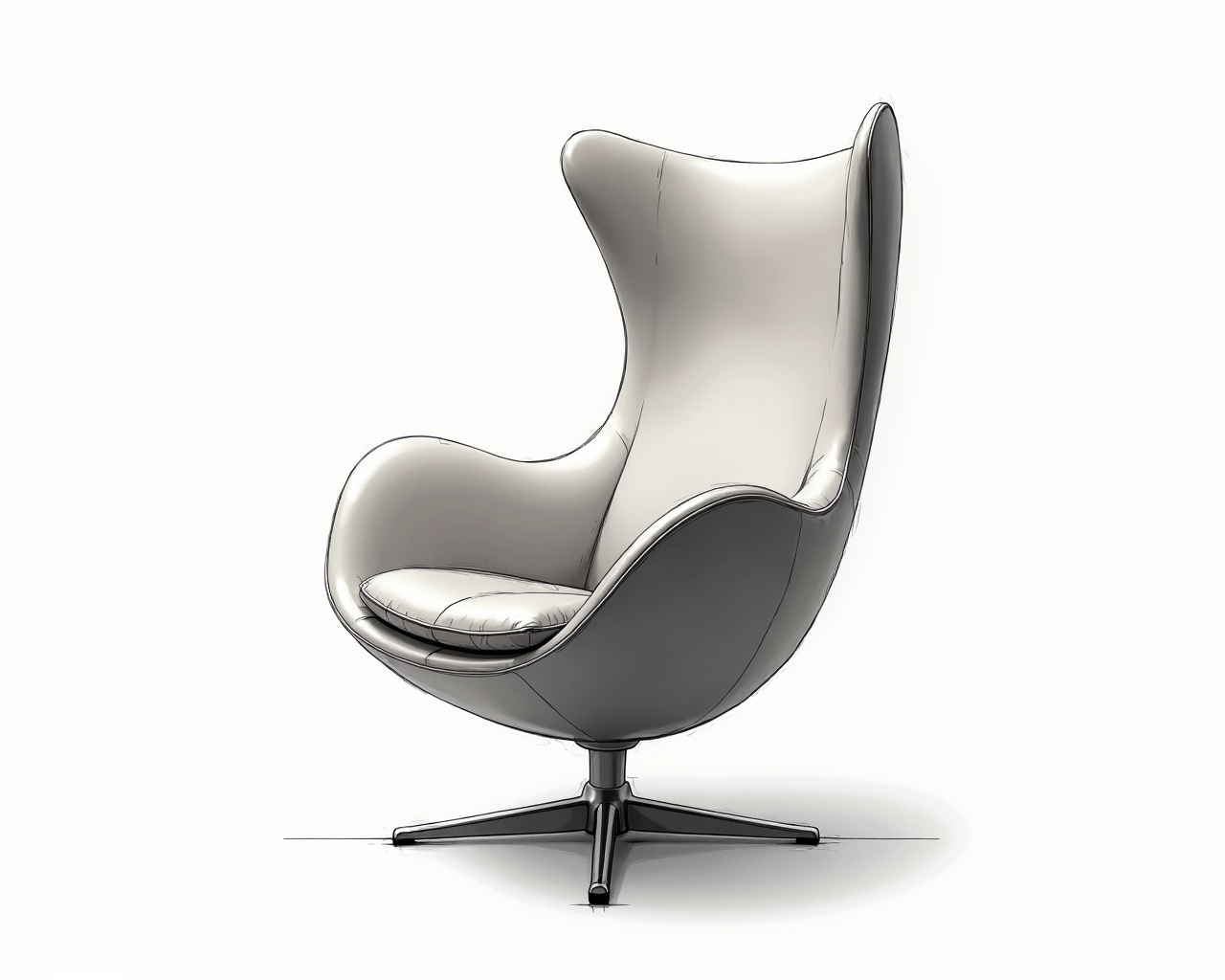
Egg Chair
The Egg Chair by Arne Jacobsen: A Masterpiece of Modernist Design
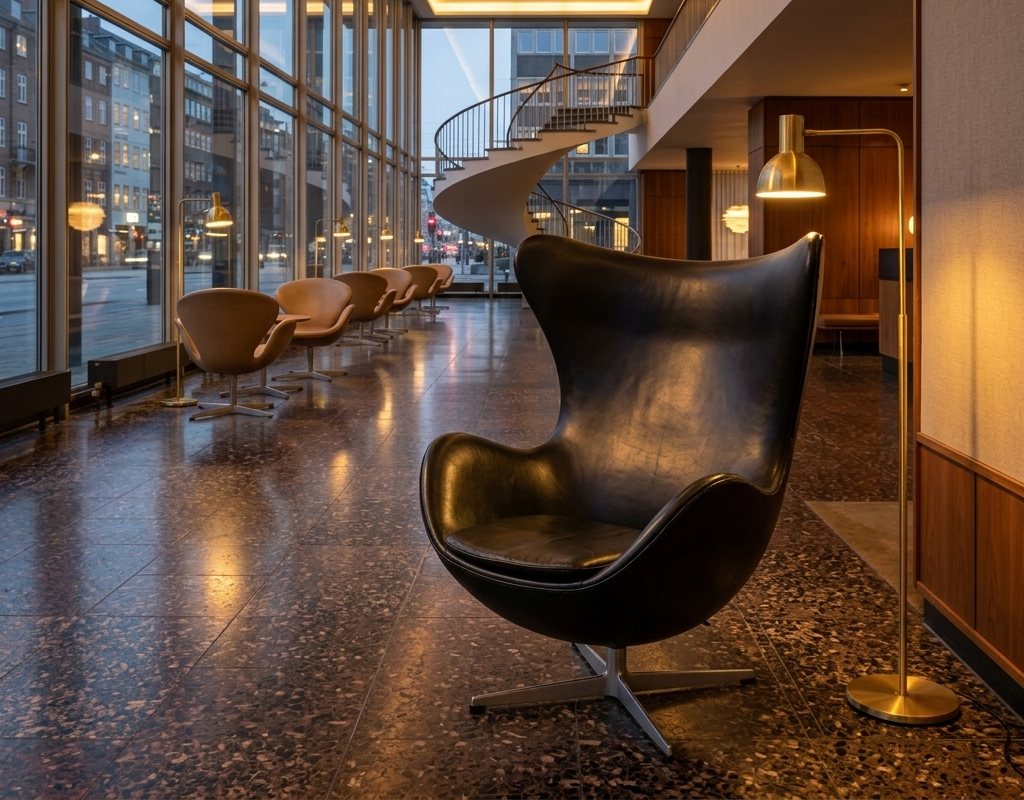
A quiet corner of the SAS Royal Hotel lobby in Copenhagen, 1960. Amid the hum of travelers, a guest reclines in a sculptural armchair unlike anything the world has seen before. Its enveloping form cradles the sitter in a cocoon of privacy, while its organic silhouette seems to defy the rigid geometry of the building around it. This is the Egg Chair, a marvel of mid-century modernism, designed by Arne Jacobsen not merely as a piece of furniture but as an experience—an ode to comfort, craft, and the human form.
The Birth of the Egg Chair: A Hotel’s Iconic Centerpiece
The Egg Chair was born out of an ambitious commission: in 1958, the Scandinavian Airlines System (SAS) tasked Arne Jacobsen with designing their new flagship hotel, the SAS Royal Hotel in Copenhagen. This was not just any assignment; Jacobsen was responsible for every detail, from the building’s façade to the light fixtures, cutlery, and furniture. It was the epitome of “total design,” a concept that sought to unify architecture and interiors into a cohesive whole [1].
The SAS Royal Hotel was envisioned as a beacon of modern luxury, catering to an international clientele during an era when air travel was the height of sophistication. The Egg Chair, designed specifically for the hotel’s lobby and reception areas, was Jacobsen’s answer to a unique challenge: how to create an intimate seating experience within a bustling public space. Its high, curved back and enveloping arms were designed to shield the sitter from the surrounding activity, offering a sense of privacy without the need for physical barriers [2].
The chair’s cocoon-like shape served both functional and aesthetic purposes. Its organic curves contrasted with the rectilinear architecture of the hotel, creating a visual tension that highlighted Jacobsen’s mastery of blending the natural with the man-made. The Egg Chair became the hotel’s signature piece, embodying the modernist ethos of form following function while exuding an air of timeless elegance [3].
Designing Comfort: The Sculptural Form and Function of the Egg Chair
Jacobsen’s design philosophy was rooted in what is often termed “organic modernism.” This approach emphasized the harmonious integration of natural forms and modern materials, aiming to create designs that were both functional and sculpturally expressive. The Egg Chair is perhaps the purest distillation of this philosophy, with its curvaceous silhouette evoking the protective embrace of a bird’s egg while serving a practical purpose: to provide comfort and privacy [4].
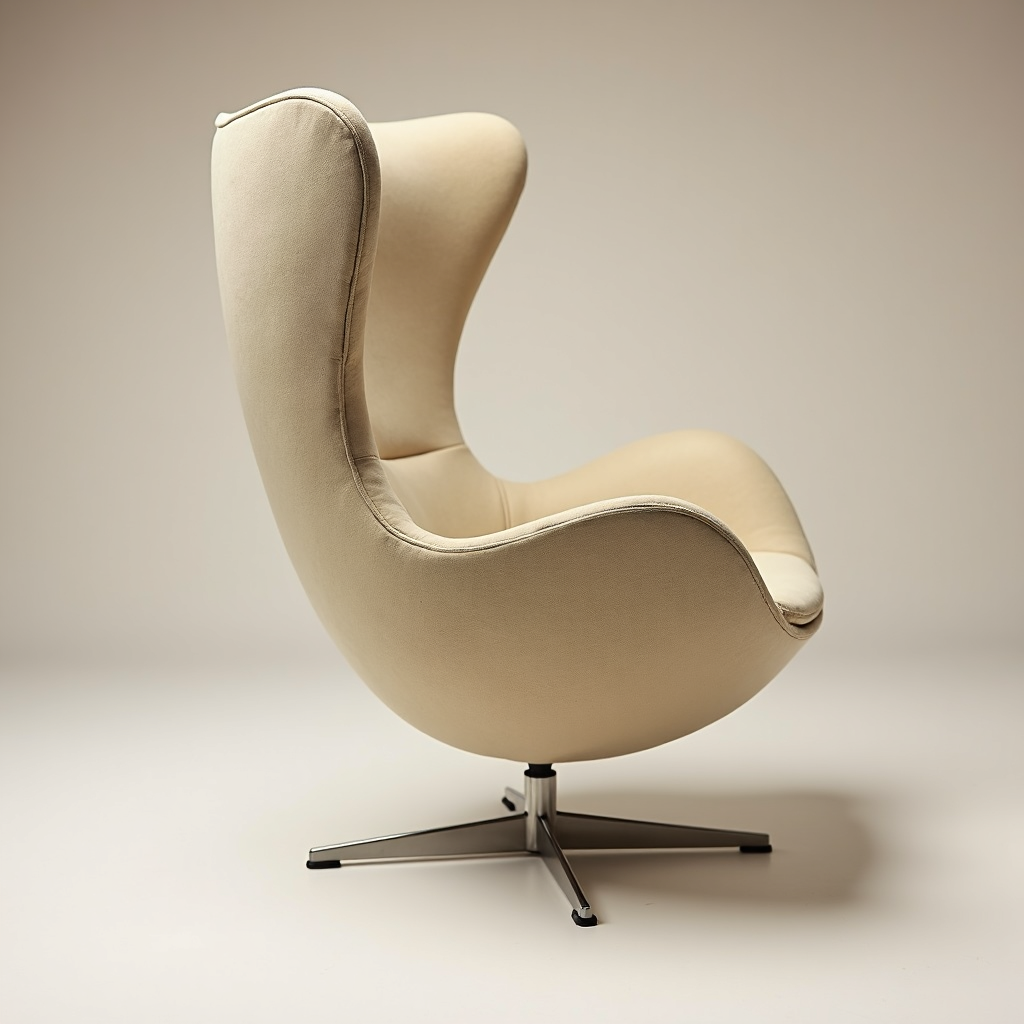
The chair’s design was groundbreaking for its time. Unlike traditional armchairs, which often relied on separate components for the seat, backrest, and arms, the Egg Chair was conceived as a single, unified form. This not only enhanced its structural integrity but also allowed Jacobsen to explore new possibilities in ergonomic design. The chair is mounted on a swivel base, enabling the sitter to turn away or toward the surrounding environment as desired, further enhancing its ability to create a personal sanctuary in public spaces [5].
Crafting the Egg: Innovation in Materials and Production
The creation of the Egg Chair was as revolutionary as its design. Jacobsen employed a then-novel technique: crafting the chair’s inner shell from a molded cold foam, which was applied over a sturdy steel frame. This approach allowed for the chair’s complex, sculptural form, which would have been impossible to achieve with traditional wood or metal construction methods [6].
Jacobsen’s design process was famously hands-on. He began by sculpting the chair’s shape in plaster, working in his garage to refine its contours. He then used this model as a basis for the final design, ensuring that every curve served both aesthetic and functional purposes. The use of foam not only enabled the creation of the chair’s distinctive shape but also provided unparalleled comfort, as the material conformed to the sitter’s body while offering firm support [7].
The chair was upholstered in either fabric or leather, with each piece meticulously hand-stitched to ensure a seamless finish. This level of craftsmanship, combined with the innovative use of materials, set a new standard in furniture design and established the Egg Chair as a symbol of modern luxury [8].
Arne Jacobsen: Architect of Modern Living
Arne Jacobsen (1902–1971) was more than a designer; he was a visionary who sought to redefine the way people lived and interacted with their environments. Trained as an architect, Jacobsen was deeply influenced by the functionalist movement, which emphasized simplicity, functionality, and the use of modern materials. His work spanned architecture, furniture, and industrial design, reflecting his belief in the interconnectedness of all aspects of human life [9].
The Egg Chair is perhaps Jacobsen’s most iconic creation, but it is far from his only contribution to design. Among his other notable works are the Swan Chair, also created for the SAS Royal Hotel, and the Ant Chair, a lightweight and stackable seating solution that became a staple of mid-century interiors. Jacobsen’s designs were characterized by their organic forms, which drew inspiration from nature, and their innovative use of materials, which pushed the boundaries of what was possible in design [10].
Jacobsen’s ability to balance form and function, art and utility, made him one of the most influential designers of the 20th century. The Egg Chair, with its perfect synthesis of comfort, craftsmanship, and aesthetic appeal, exemplifies his genius.
The Legacy of the Egg Chair: From Copenhagen to the World
More than six decades after its debut, the Egg Chair remains a paragon of modern design. Its timeless appeal has made it a sought-after collector’s item, with original models fetching high prices at auctions. The chair is also a staple in the collections of major museums, including the Museum of Modern Art (MoMA) in New York, where it is celebrated as a masterpiece of mid-century design [11].
The Egg Chair’s influence extends beyond the world of design. It has become a cultural icon, appearing in numerous films, television shows, and advertisements as a symbol of sophistication and modernity. From the sleek offices of high-powered executives to the stylish interiors of luxury hotels, the Egg Chair continues to be a fixture in spaces that value both form and function [12].
However, its popularity has also made it a target for counterfeiters. The market for replica Egg Chairs is vast, and distinguishing an authentic piece from a forgery can be challenging. Authentic models manufactured by Fritz Hansen, the exclusive producer of the chair, are marked with a unique label, a practice that has evolved over the years to help buyers identify genuine pieces. This ongoing issue highlights the chair’s enduring value and the high regard in which it is held by design enthusiasts [13].
Why the Egg Chair Endures
The Egg Chair’s enduring appeal lies in its ability to transcend its original context. While it was designed for the SAS Royal Hotel, its sculptural form and innovative construction have made it a versatile piece that fits seamlessly into a variety of settings, from corporate offices to private living rooms. Its design is both a product of its time and a timeless expression of comfort and elegance.
Moreover, the Egg Chair exemplifies the best of mid-century modernism, a design movement that continues to resonate with contemporary audiences. Its focus on simplicity, functionality, and the use of modern materials aligns with today’s emphasis on sustainable and thoughtful design. By creating a chair that is as comfortable as it is beautiful, Jacobsen ensured that the Egg would remain relevant, even as tastes and trends have evolved [15].
The Egg Chair is more than a piece of furniture; it is a work of art, a cultural icon, and a testament to the power of thoughtful design. As it continues to grace living rooms, lobbies, and museums around the world, it serves as a reminder of Arne Jacobsen’s unparalleled ability to marry form and function, creating objects that are as timeless as they are innovative.
References
- Olson & Baker. “The Egg Chair: A History of the Genuine Arne Jacobsen Design.” Link
- Arne Jacobsen Official Website. “The Egg.” Link
- Cherished Designs. “Arne Jacobsen Egg Chair.” Link
- Dezeen. “Arne Jacobsen Egg Chair.” Link
- Fritz Hansen Official Website. “Egg Chair.” Link
- MoMA. “Egg Chair by Arne Jacobsen.” Link