Tulip Chair
The Tulip Chair: A Revolution in Form and Function
It’s easy to take the chair for granted. Ubiquitous and necessary, it is both a symbol of rest and a vessel for function. But in the mid-20th century, one designer saw in the chair an opportunity for reinvention. Eero Saarinen, the Finnish-American architect and designer, looked at a world cluttered with four-legged chairs and tables, and saw chaos. He envisioned a chair that would not only serve its purpose but would also declutter the visual noise of the modern interior. His journey to create the Tulip Chair wasn’t just about furniture—it was about sculpting a new paradigm of how we live and move through space.
The Quest to Tidy the “Slum of Legs”
Eero Saarinen’s Tulip Chair, designed between 1955 and 1956 and brought to life by the avant-garde furniture manufacturer Knoll, emerged as part of his larger effort to solve a problem most people didn’t even realize existed. Saarinen was perturbed by what he called the “ugly, confusing, unrestful world” created by the multiple legs of tables and chairs in a room. He described this as the “slum of legs,” and his solution was not merely to refine—it was to revolutionize [1][2].
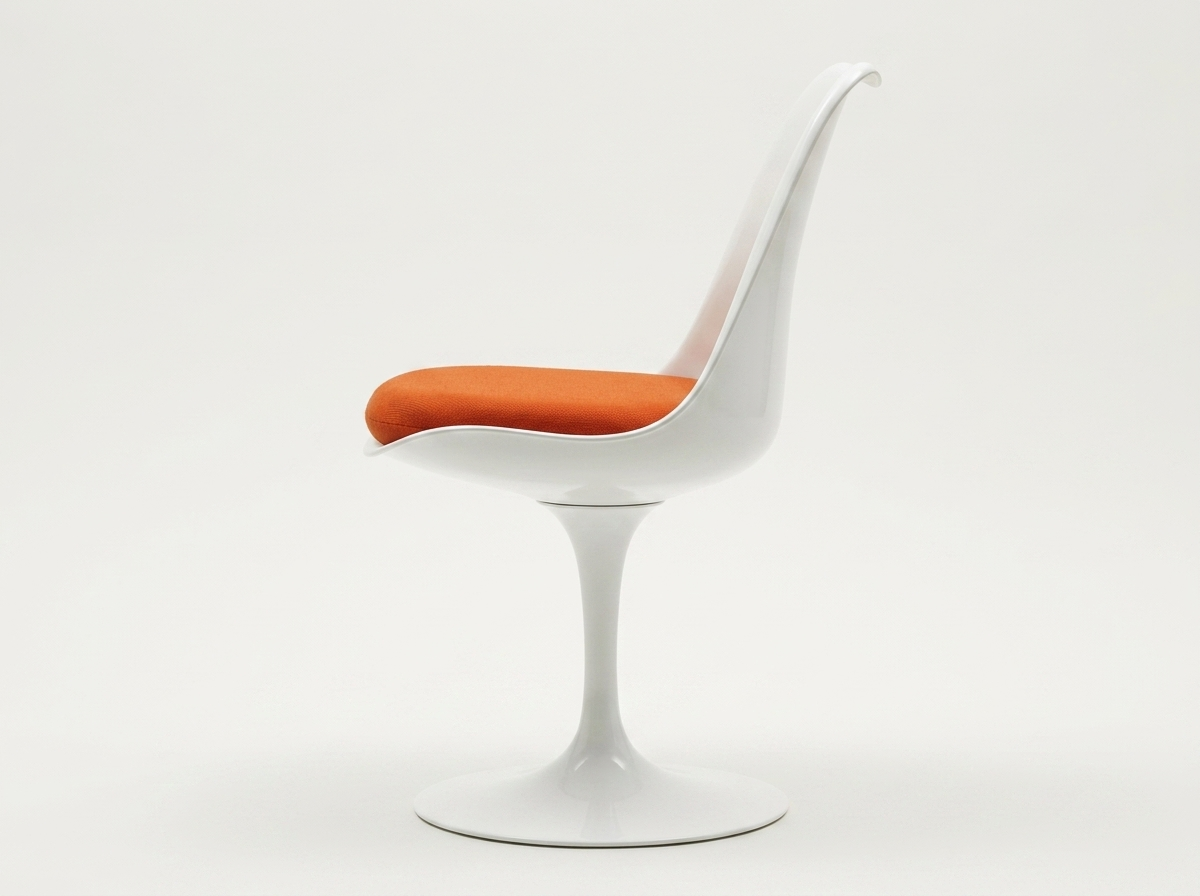
The Tulip Chair debuted in 1958 as part of Saarinen’s groundbreaking Pedestal Collection. The series included tables and chairs unified by a single, sweeping pedestal base. This design eliminated the traditional four-legged structure and instead introduced a singular stem-like support, a feat of engineering and aesthetics that created a clean, flowing silhouette. The result was a chair that felt as much a sculpture as it was a piece of functional furniture [1].
But achieving this seamless form wasn’t straightforward. Saarinen’s original vision was a chair made entirely from a single material, appearing as though it had been sculpted from one continuous piece. However, the technology of the time couldn’t support such a feat. Instead, the Tulip Chair combines a fiberglass shell for the seat and an aluminum base with a plastic finish, achieving the illusion of unity while meeting practical manufacturing constraints [2][3].
A Sculptor’s Approach to Design
To understand the Tulip Chair, one must first understand its creator. Born in 1910 in Kirkkonummi, Finland, Eero Saarinen was the son of renowned architect Eliel Saarinen and textile artist Loja Saarinen. Growing up in a household steeped in creativity, young Eero was surrounded by design from an early age. Initially, he studied sculpture in Paris before transitioning to architecture at Yale University. This dual foundation—melding form and function—became the hallmark of his career [3][4].
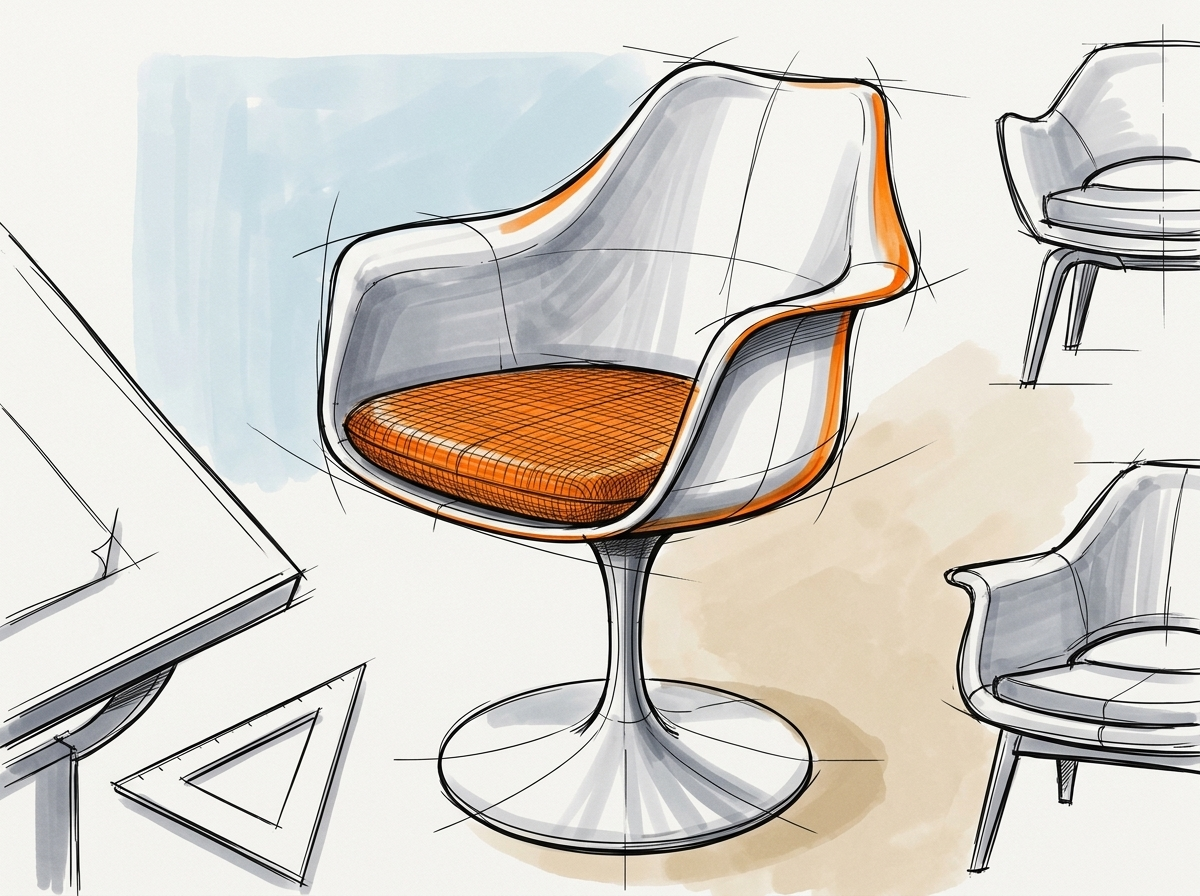
Saarinen’s architectural works, such as the TWA Flight Center at JFK Airport and the Gateway Arch in St. Louis, are celebrated for their sculptural qualities and bold, futuristic forms. This same ethos permeated his furniture designs. For the Tulip Chair, Saarinen approached the design process as a sculptor might, creating full-scale models and handcrafting clay prototypes to test proportions and ergonomics. His own family served as test subjects, offering feedback as they sat in the evolving prototypes. This iterative process ensured that the final product was not just beautiful but also supremely comfortable [1][2].
Saarinen’s partnership with Knoll was instrumental in bringing his ideas to life. He began collaborating with Florence Knoll in the 1940s, and their shared vision for modern design culminated in some of the most iconic furniture of the 20th century. The Tulip Chair stands as a testament to their commitment to pushing boundaries, both aesthetically and technically [3].
The Chair That Looked to the Future
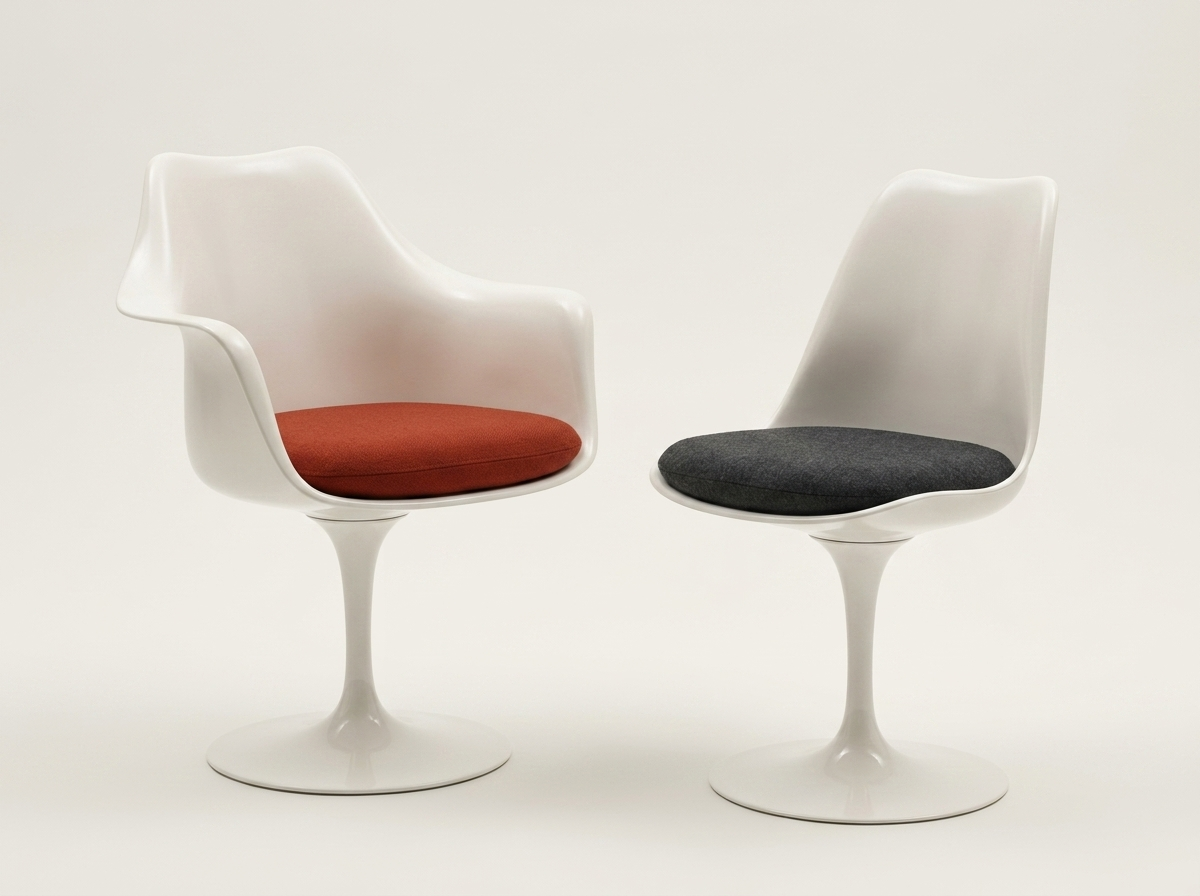
From the moment it was unveiled, the Tulip Chair was hailed as a triumph of modern design. Its futuristic aesthetic, with its smooth curves and pedestal base, made it an immediate icon of the Mid-Century Modern movement. It wasn’t just a chair; it was a statement about the future of living, where simplicity and elegance could coexist with functionality [2].
The chair’s cultural impact was almost immediate. Its space-age design found a natural home in pop culture, most notably appearing on the bridge of the USS Enterprise in the original Star Trek series. The Tulip Chair effortlessly embodied the forward-thinking, optimistic vision of the future that defined the 1960s [3].
Yet the chair was more than a symbol of modernity. It was also a practical invention. The pedestal base made it easy to clean around and under, a small but meaningful improvement for modern households. Its lightweight fiberglass shell offered comfort and flexibility, making it suitable for both dining and lounging. In this way, the Tulip Chair bridged the gap between high design and everyday life [1][3].
The Journey from Prototype to Icon
The road to creating the Tulip Chair was not without its challenges. Saarinen envisioned a chair that would appear as though it had grown from the ground, its contours organic and uninterrupted. Initially, he aimed to use a single material to achieve the seamless look he desired. However, the limitations of mid-century manufacturing technology made this impossible [2].
To overcome these obstacles, Saarinen collaborated closely with Knoll’s Design Development Group, led by engineer Don Petitt. Together, they developed innovative techniques to realize Saarinen’s vision. The fiberglass seat was molded to provide a sleek, ergonomic form, while the aluminum pedestal base was coated with a plastic finish to match the seat’s surface. This combination of materials was a masterstroke, allowing the chair to achieve its signature aesthetic and structural integrity [2][4].
The development process also involved rigorous testing. Prototypes were subjected to extreme conditions to ensure their durability. In one test, the chair was loaded with the weight of a 300-pound person to simulate the stress of daily use. Such meticulous attention to detail underscored Saarinen’s commitment to creating a chair that was as practical as it was beautiful [4].
Why the Tulip Chair Endures
The Tulip Chair’s enduring appeal lies in its ability to transcend time and trends. Over six decades after its debut, it continues to be a staple in design-conscious homes and public spaces around the world. Its clean lines and sculptural form make it as relevant today as it was in the 1950s, a testament to Saarinen’s visionary approach to design [1].
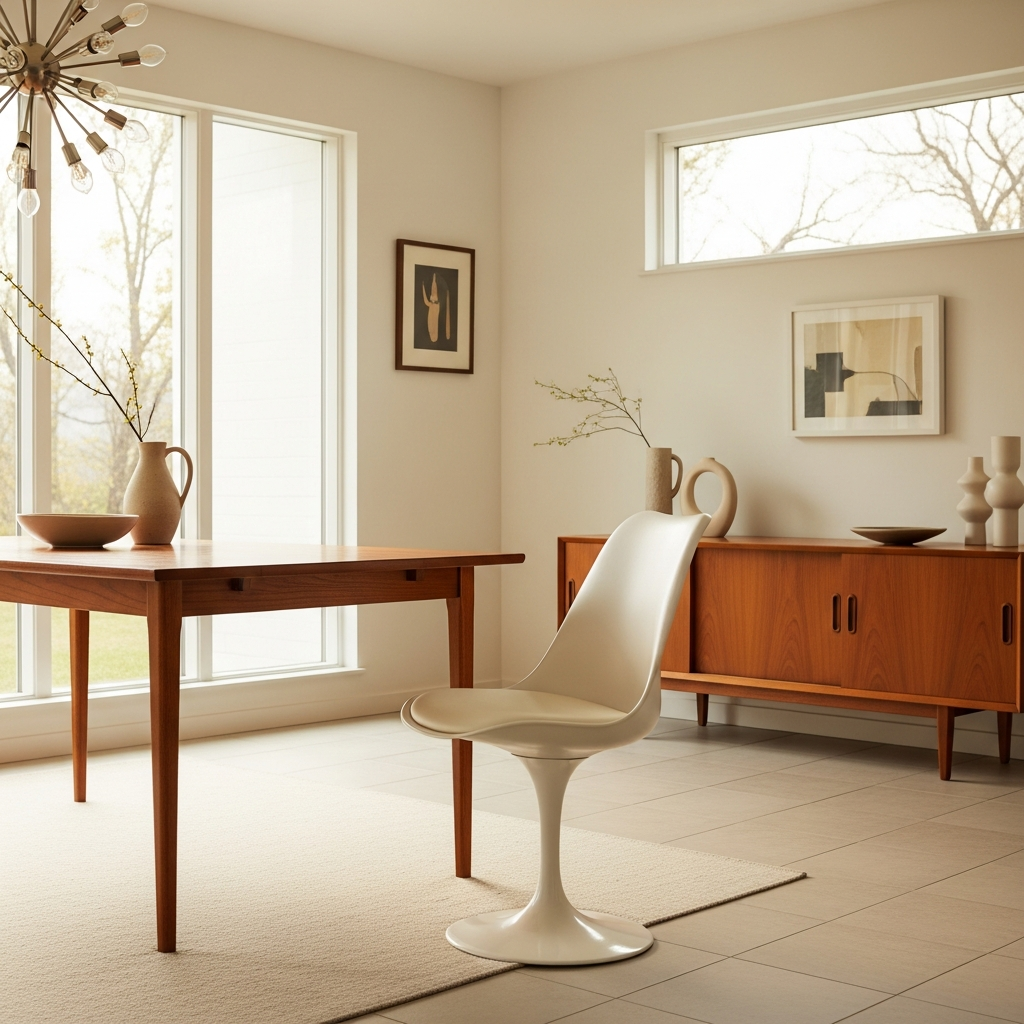
Part of the chair’s lasting legacy is its ability to adapt to different contexts. Available in a range of finishes and upholstery options, the Tulip Chair can seamlessly integrate into a variety of interiors, from minimalist modern apartments to eclectic, art-filled spaces. Its versatility has made it a favorite among architects and interior designers, who appreciate its ability to elevate any setting with its understated elegance [2].
The Tulip Chair also holds a special place in the history of design. It is a quintessential example of the Mid-Century Modern movement, a period that redefined design by emphasizing simplicity, functionality, and a connection to nature. Saarinen’s work has inspired generations of designers, and the Tulip Chair remains a symbol of the transformative power of design [3].
Meet the Designer
Eero Saarinen was no ordinary designer. His career spanned architecture, furniture, and urban planning, each discipline enriched by his unique approach to form and function. Born into a family of artists, Saarinen was destined for a life in design. His father, Eliel Saarinen, was a towering figure in early 20th-century architecture, and his mother, Loja Saarinen, was a talented textile artist. This creative upbringing instilled in Eero a profound appreciation for the interplay between aesthetics and utility [3].
After studying sculpture in Paris and architecture at Yale, Saarinen returned to the United States, where he began collaborating with his father on projects that fused traditional and modernist principles. But it was his partnership with Florence Knoll that truly allowed his creative vision to flourish. Together, they challenged the conventions of furniture design, producing iconic pieces like the Womb Chair, the Executive Chair, and, of course, the Tulip Chair [3][4].
Saarinen’s architectural achievements are equally celebrated. His designs for the Gateway Arch and the TWA Flight Center remain landmarks of modern architecture, embodying his belief in the power of form to inspire and uplift. Tragically, Saarinen’s life was cut short in 1961, but his legacy endures in the timelessness of his designs [2][3].
The Legacy of the Tulip Chair
The Tulip Chair is more than just a piece of furniture; it’s a cultural artifact, a symbol of an era that looked to the future with optimism and imagination. Its influence can be seen in countless designs that followed, from the organic forms of the 1960s and ’70s to the minimalist aesthetics of today. Its innovative use of materials and commitment to function over ornamentation set a new standard for modern design [2][3].
Today, the Tulip Chair is celebrated in museums and design collections around the world, including the Victoria & Albert Museum in London. It remains in production by Knoll, ensuring that new generations can experience its timeless appeal firsthand. Whether as a dining chair, an office chair, or a standalone piece of art, the Tulip Chair continues to captivate and inspire [4].
Eero Saarinen once said, “The purpose of architecture is to shelter and enhance man’s life on earth and to fulfill his belief in the nobility of his existence.” The Tulip Chair, in its elegant simplicity, does just that. It is a chair that transcends its function, inviting us to consider not just where we sit, but how we live.