Ant Chair
The Ant Chair by Arne Jacobsen: A Revolution in Three Legs
The year is 1952, and the clatter of utensils and low hum of conversation fill the cafeteria of Novo Nordisk, a Danish pharmaceutical company. Amid the lunch-hour murmur, a sleek, three-legged chair commands attention. It’s a curious sight: minimal, almost skeletal in its construction, with a sinuous backrest that appears to hover effortlessly. Patrons lean back, gingerly at first, but soon discover the unexpected stability of this peculiar creation. This is the Ant Chair, the brainchild of Arne Jacobsen, a design maverick who, with this single piece of furniture, would redefine the way we sit, dine, and interact with modern design.
The Concept: A Chair for Modern Living
In post-war Denmark, the air was charged with a spirit of reinvention. Danish designers, inspired by the Bauhaus and the emerging organic modernism of figures like Charles and Ray Eames, sought to create pieces that married functionality with aesthetic purity. Arne Jacobsen, already an established architect, was at the forefront of this movement, which would come to be known as Danish Modernism. When Novo Nordisk commissioned him to design seating for their canteen, Jacobsen seized the opportunity to challenge conventions.
The brief called for a chair that was lightweight, stackable, and suitable for high-volume production. Jacobsen, ever the contrarian, decided to take the challenge a step further. Why should a chair have four legs when three could suffice? Why should it be heavy when it could be light as air? And why should it be merely functional when it could also be a sculptural masterpiece? These questions became the foundation for what would become the Ant Chair—a symbol of modern living that emphasized simplicity without sacrificing elegance.
The Design: Plywood, Curves, and Three Legs
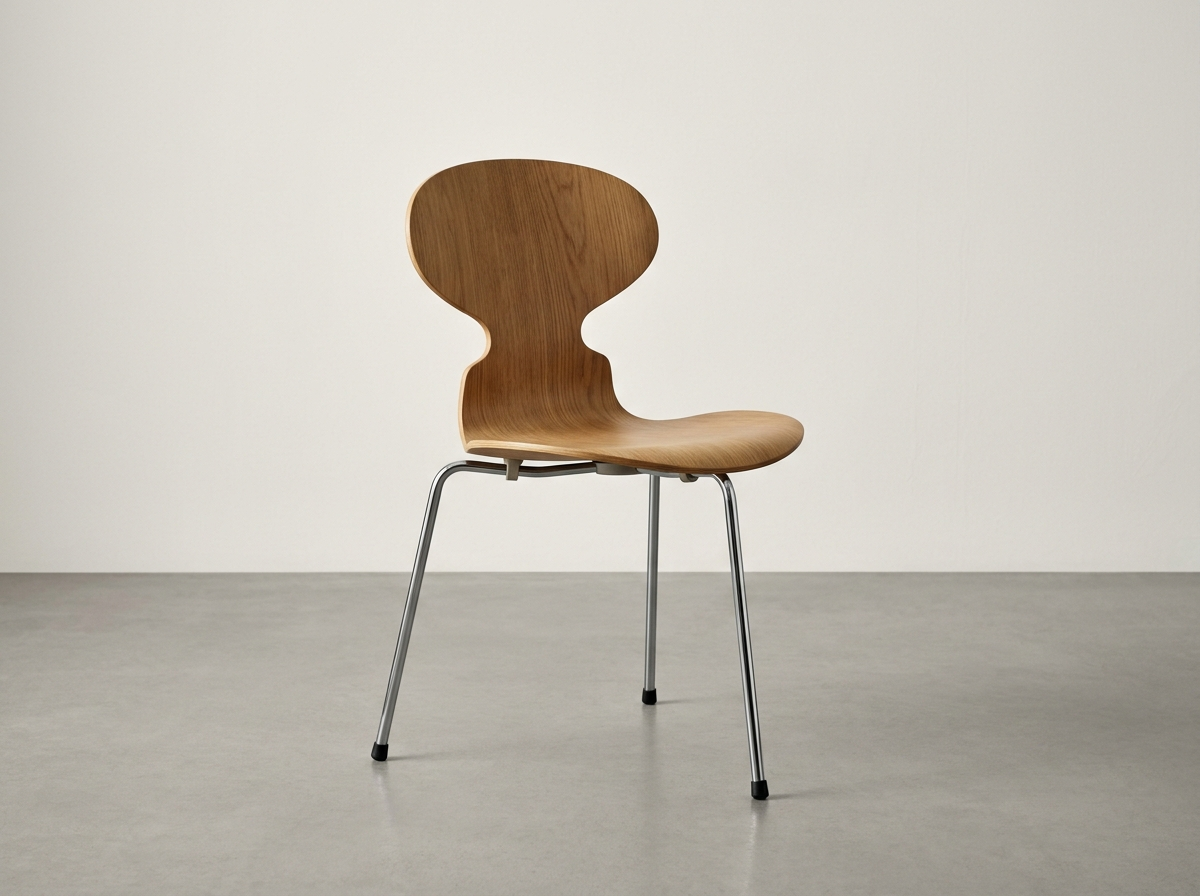
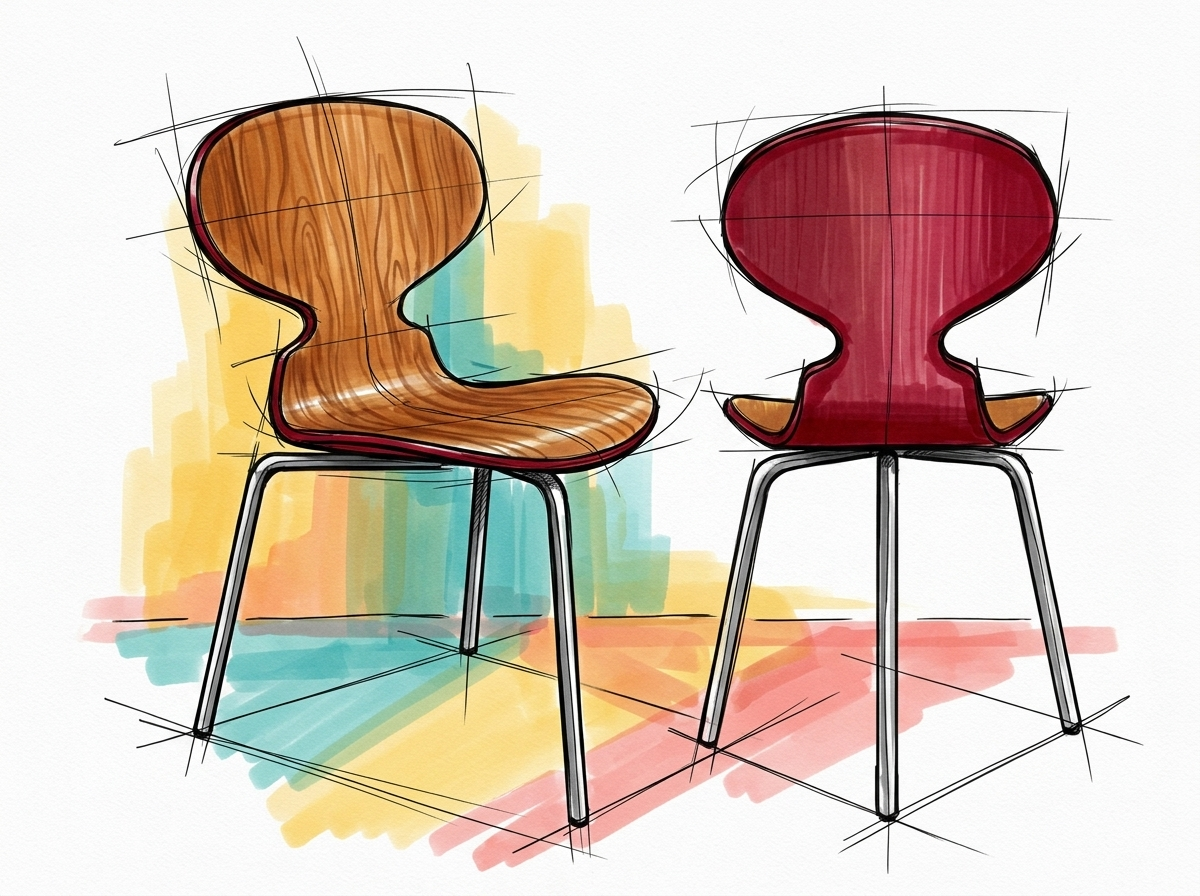
The Ant Chair’s silhouette is unmistakable: a single, fluid piece of molded plywood forms both the seat and backrest, with a narrow “waist” that gives the chair its insect-inspired name. The backrest curves gently, cradling the sitter’s spine, while the seat dips subtly for comfort. The use of molded plywood—a technique pioneered by the Eameses in the 1940s—allowed Jacobsen to create a form that was both lightweight and robust. The chair’s original version featured three legs made of plastic-coated steel, later replaced by tubular steel for added durability.
Jacobsen’s decision to use three legs was as much a philosophical statement as a practical one. “Why should a chair have four legs when three are enough?” he famously asked [1]. This minimalist approach was not without its challenges. Critics initially questioned the chair’s stability, but Jacobsen’s meticulous engineering ensured that the three-legged design was not only stable but also remarkably elegant. The legs were angled precisely to distribute weight evenly, and the chair’s slight flexibility added a sense of comfort and resilience.
The Making: Fritz Hansen’s Craftsmanship
To bring his vision to life, Jacobsen turned to Fritz Hansen, a Danish furniture manufacturer with whom he had been collaborating since 1934. At the time, Fritz Hansen was known for its expertise in steam-bent wood, a technique that allowed for the creation of curved, organic forms. The partnership between Jacobsen and Fritz Hansen would prove to be transformative for both parties, culminating in a series of iconic designs, including the Egg and Swan chairs.
The Ant Chair, however, was a risk. Initially, Fritz Hansen was reluctant to produce the chair, skeptical of its unconventional design and commercial viability. It wasn’t until Novo Nordisk placed an order for 300 units that the manufacturer agreed to proceed [2]. The production process itself was groundbreaking. The chair’s seat and backrest were crafted from nine layers of laminated veneer, with two internal layers of cotton textile for added strength and flexibility [3]. This innovative use of materials ensured that the chair was not only lightweight but also capable of withstanding the rigors of daily use in a bustling cafeteria.
Meet the Designer: Arne Jacobsen
Arne Jacobsen (1902–1971) is often described as the father of Danish Modernism, a title he earned through decades of groundbreaking work in architecture and design. Born in Copenhagen, Jacobsen initially trained as a mason before studying architecture at the Royal Danish Academy of Fine Arts. His early work was deeply influenced by the functionalist principles of the Bauhaus, but he soon developed a style that balanced modernist rigor with organic forms and a keen attention to detail [4].
Jacobsen’s collaboration with Fritz Hansen began in the 1930s and marked a turning point in his career. Together, they explored the possibilities of molded plywood, a material that allowed for the creation of furniture that was both functional and sculptural. The Ant Chair was a watershed moment, solidifying Jacobsen’s reputation as a designer who could marry form and function in ways that were both innovative and deeply human.
But Jacobsen was not without his controversies. His insistence on the three-legged design of the Ant Chair was met with skepticism, even ridicule. Yet, his unwavering commitment to his vision—rooted in a belief that good design should challenge conventions—ultimately proved transformative. The success of the Ant Chair paved the way for subsequent masterpieces, including the Series 7, the Egg, and the Swan chairs, all of which remain icons of 20th-century design [5].
Why the Ant Chair Endures
More than 70 years after its debut, the Ant Chair remains a fixture in homes, offices, and museums around the world. Its enduring appeal lies in its ability to balance competing demands: it is at once functional and beautiful, simple and sophisticated, industrial and organic. Its stackable design makes it practical for communal spaces, while its sculptural form elevates any setting.
The chair’s influence extends far beyond its practical applications. It has been featured in numerous exhibitions, including its debut at the Danish Society of Arts and Crafts exhibition in Zurich in 1952 and a subsequent showing at the Danish Museum of Decorative Arts in 1953 [6]. Today, it is part of the permanent collection at Design Museum Denmark, among other prestigious institutions [7].
The Ant Chair also holds a special place in the history of furniture design as one of the earliest examples of mass-produced modernist furniture that did not sacrifice quality for quantity. Jacobsen’s meticulous attention to detail, combined with Fritz Hansen’s manufacturing expertise, ensured that each chair retained a sense of craftsmanship, even as thousands rolled off the production line [8].
A Legacy in Three Legs
The Ant Chair is more than a piece of furniture; it is a manifesto in plywood and steel. It challenges us to reconsider our assumptions about design, to see beauty in simplicity, and to embrace innovation even in the face of skepticism. It is a testament to the power of collaboration, the potential of new materials, and the enduring genius of Arne Jacobsen.
As we sit on an Ant Chair—whether in a bustling café, a modern office, or the hallowed halls of a museum—we are reminded of its revolutionary spirit. It’s a chair that doesn’t just support us; it invites us to sit with intention, to appreciate the artistry in everyday objects, and to celebrate the extraordinary potential of design.