The Eames Lounge Chair: A Modern Classic of Comfort and Craft
On a January evening in 1956, television audiences tuned to Arlene Francis’ Home show on NBC witnessed a curious scene: Charles Eames, one of the era’s most celebrated designers, perched somewhat awkwardly beside his latest creation — a sleek, low-slung lounge chair and ottoman that had only just emerged from the workshop. [1] It was a moment of quiet television history that almost no one recognized as such at the time.
Meet the Designer Charles & Ray Eames — The husband-and-wife partnership that reshaped mid-century American design through furniture, film, architecture, and exhibitions of radical democratic optimism.
Related Chairs
- Barcelona Chair (coming soon)
- Tulip Chair (coming soon)
- Womb Chair (coming soon)
- Diamond Chair (coming soon)
The chair, he explained to Francis and her viewers, aspired to the feel of “a well-used first baseman’s mitt.” [2] Not stiff. Not formal. Not the rectilinear geometry his studio had become famous for. Something warm, yielding, human — built from the same modern materials and manufacturing logic as his celebrated plywood chairs, but devoted entirely to a single purpose: deep, unhurried rest.
More than sixty years later, the Eames Lounge Chair (Herman Miller model 670) and its companion Ottoman (model 671) still ship, still sell, and still appear in the studies and living rooms of people who think carefully about what surrounds them. It has become perhaps the most recognized piece of furniture in the postwar world — not just an icon, but a genuinely excellent chair. Those two things, in furniture, do not always coincide.
The Concept: An English Club Chair, Reimagined
By the mid-1950s, Charles and Ray Eames had already transformed American furniture design. The molded plywood chairs, the fibreglass shell chair, the wire chair — these were democratic objects: beautiful, structurally intelligent, and, crucially, affordable. They were designed to inhabit the modern world broadly, not to be collected by the privileged few. [2]
The Lounge Chair was a conscious departure. It was the first piece the Eames Office conceived as an explicitly luxury object — something that acknowledged cost, craft, and longevity in a way their earlier work had deliberately sidestepped. The reference design was the English club chair: that broad, deep, leather-covered institution of the gentleman’s study and the private members’ club, built to absorb its owners into prolonged reading, slow thinking, and unhurried conversation since the Victorian era. [1]
Charles admired these chairs deeply but found them static and stubborn. They held you in one position like a well-upholstered throne — generous, but ultimately immovable. He wanted the same depth of comfort arranged differently: a chair that, as the hang tag affixed to early production models put it, “invites the sitter to shift position, to adjust, to swivel, to recline.” [2] The cushions would float on down feathers. The back would tilt. The whole assembly would swivel freely on its cast-aluminum base. Rather than fixing you in place, it would move with you as the afternoon moved.
This sounds like a modest ambition until you try to achieve it in physical materials without the chair feeling mechanical. Every feature the hang tag describes — the tilt, the swivel, the floating cushions, the freedom of movement — had to be engineered carefully enough to seem effortless in use. The Lounge Chair should not feel like a machine. It should feel like rest.
It was also, Charles told interviewers, the first piece he had designed that he personally wanted to own and keep. After years of designing for the broadest possible audience, this was something different: something specific, personal, and intended to outlast the people who bought it. The hang tag was explicit on this point too — calling it, with quiet ambition, the Eameses’ first heirloom piece. [2] That shift in intention — from designing for everyone to designing something worth inheriting — shows in every detail.
The Design: Three Shells, One Silhouette
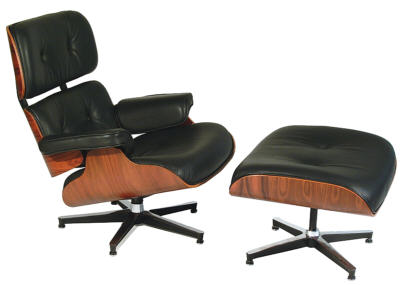
Structurally, the chair resolves into three distinct curved plywood shells — headrest, backrest, and seat — each a compound curve molded under heat and hydraulic pressure, upholstered in leather and connected to a five-pronged polished aluminum swivel base. The overall composition is one of the most analyzed silhouettes in modern design history, and it rewards that attention. [1]
The shells are not merely structural. Each curve performs several functions simultaneously: it provides rigidity without mass, ergonomic support without constraint, and an aesthetic warmth that no flat surface could achieve. Viewed from the side, the chair presents a series of interlocking arcs that seem to lean gently toward the sitter — generous, almost beckoning. This is not accidental. The geometry was iterated over years of prototype testing until the proportions felt psychologically as well as physically correct — until the chair, in Charles’s phrase, looked receptive.
The original veneer was Brazilian rosewood (Dalbergia nigra), chosen for its deep, richly figured grain and the tactile warmth it brought to what might otherwise read as a cold, industrial object. [1] The combination of that dark, variably patterned wood with black leather — the standard early upholstery option — produced an interior warmth that was immediately legible and genuinely distinctive. Every piece of rosewood veneer was different; every early chair was, in the small ways that matter in furniture, unique.
Between the backrest and seat shells sits the chair’s most technically interesting component: a rubber shock mount that joins the two forms with a slight, elastic give. Press your back into the backrest and it breathes fractionally against you — a movement so subtle that most sitters never consciously register it, but one that accounts for a significant portion of the chair’s perceived comfort over long hours. [3] The engineers at Herman Miller spent considerable time calibrating that flex. Too stiff and it disappears; too loose and the chair feels unmoored.
The three leather cushions — spanning seat, backrest, and headrest — are attached with leather straps and buttons rather than adhesive. This is both aesthetically appropriate and practically deliberate: each cushion is independently replaceable. When the leather wears, or if you want to change colour or material, the cushions come off cleanly without touching the shells. The chair anticipated its own aging, which is a rare and admirable quality in a product of any kind.
The Ottoman (model 671) extends the same visual logic at lower height: a single curved seat shell, a matching cushion, rotating on a shorter aluminum base. Together, the 670 and 671 form a visual composition that has been photographed more often than perhaps any other furniture pairing in history. [2] They are designed to be used separately — the chair functions perfectly without the ottoman — but they are most fully themselves together.
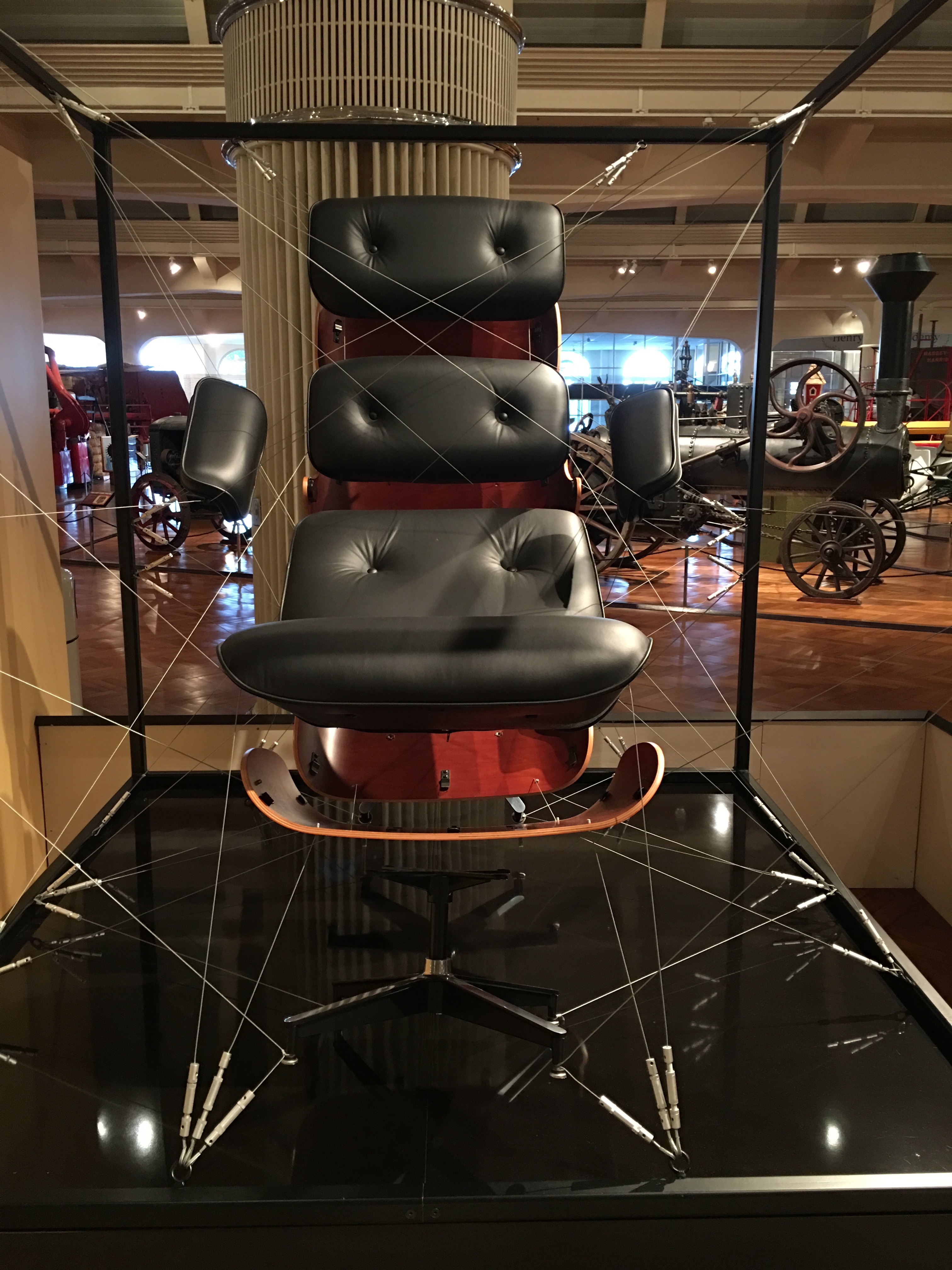
Caption:Exploded-view installation highlights the chair's shell, cushion, and base construction logic.
Source: Wikimedia Commons: https://commons.wikimedia.org/wiki/File:Exploded_Eames_Lounge_Chair_and_Ottoman_(2006)_Sculpture_designed_by_Vincent_Faust._Components_made_by_Herman_Miller._Chair_designed_by_Ray_%26_Charles_Eames_(ID2008.7.1)_-_Fully_Furnished_-_Historic_Furniture_Exhibit_-_Henry_Ford_Museum.jpg
License: cc_by_sa
Origin:public_domain
Alt Status: actual
The Craft: A Thirty-Year Flash of Inspiration
Charles Eames, characteristically modest about the chair’s apparent inevitability, called it “a thirty-year flash of inspiration” — crediting the decades of plywood research that preceded it rather than any single moment of genius. [3] That history ran all the way back to a government contract in 1942.
During World War II, Charles and Ray developed molded plywood leg splints for the U.S. Navy. The process they refined — vacuum-bag molding, in which thin veneer sheets coated with resin were pressed into curved forms and heat-cured — produced components that were light, strong, and precisely shaped. [2] The Navy valued these qualities for medical equipment. The Eameses recognized them as the foundation of a new furniture vocabulary. The experience of solving an industrial problem under wartime urgency gave them both the technique and the confidence to push it into genuinely new territory.
The postwar Molded Plywood chairs (the LCW and DCW, introduced in 1946) pushed that technique into compound curves — surfaces that bend simultaneously in two directions, which no single piece of laminate had reliably managed before. Each breakthrough required new solutions: veneer layers that curved cleanly in one axis tended to crack along the grain when forced into a second curvature. Adhesives adequate at room temperature failed under thermal stress. [3] The Eames Office ran these material experiments continuously through the late 1940s and early 1950s, accumulating a working knowledge of bent wood that was unmatched anywhere in American manufacturing.
By the time the Lounge Chair was being developed in earnest — 1955 into 1956 — the team had settled on a 5-ply shell construction: five alternating layers of veneer, each rotated 90° from the last for cross-grain strength, bonded under precisely controlled temperature and pressure in custom hydraulic molds. The compound curves of all three shells were tested across dozens of prototypes before the geometry was locked in. Shells that cracked at the edges, or that springback-deformed as the press opened, were remade until every form held perfectly and repeatably. [3]
Full production began at Herman Miller’s Zeeland, Michigan facility in 1956 and has continued there, without interruption, ever since. In Europe, the Swiss design manufacturer Vitra produces the chair under a licensing arrangement dating to the same era, applying identical specifications for European markets. [1]
Collectors identify first-generation chairs (1956–1959) by several small but telling details: arm pads secured with visible screws at the pad ends; metal Herman Miller identification plates rather than paper labels affixed to the underside of the seat shell; and rosewood veneer of a figure and depth reflecting the quality of Dalbergia nigra stock available before the species came under international protection. [3] When Brazil listed Brazilian rosewood as endangered in 1992 and restricted its export, both Herman Miller and Vitra transitioned to alternative veneers — walnut, cherry, santos palisander — that honour the spirit of the original while meeting contemporary environmental standards. [1]
Despite those material substitutions, and despite refinements accumulated across seven decades of continuous production, the chair’s fundamental geometry has never changed. The three shell curves, the aluminum base, the shock-mount connection, the cushion proportions: these remain exactly as Charles and Ray resolved them in 1955 and 1956.
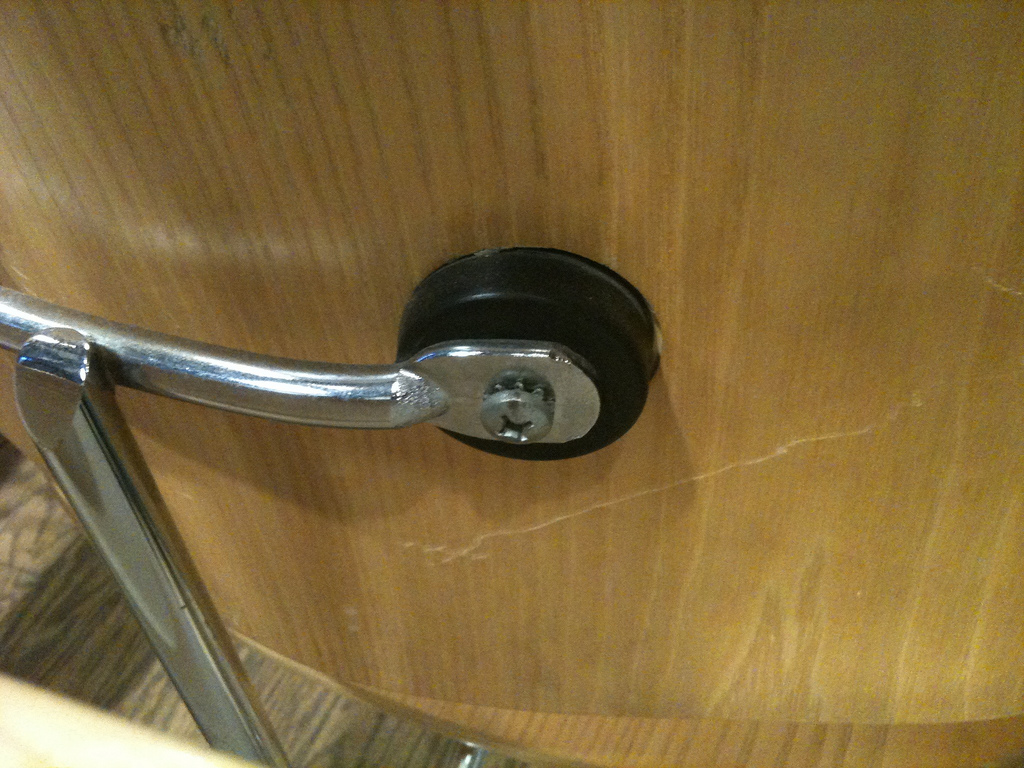
Caption:Shock-mount detail documents one of the Eameses' key comfort and durability innovations.
Source: Wikimedia Commons: https://commons.wikimedia.org/wiki/File:Eames_LCW_shock_mount.jpg
License: cc_by_sa
Origin:public_domain
Alt Status: actual
Why It Endures: More Than an Icon
The Eames Lounge Chair won the Grand Prize at the XI Milan Triennale in 1957 — its first year eligible for the competition — and entered the permanent collection of the Museum of Modern Art in New York shortly thereafter, where it remains on display today not as an artefact but as a living design. [1] [2] Both recognitions formalised what the design community had already intuited: that this was not a successful product launch but a significant object.
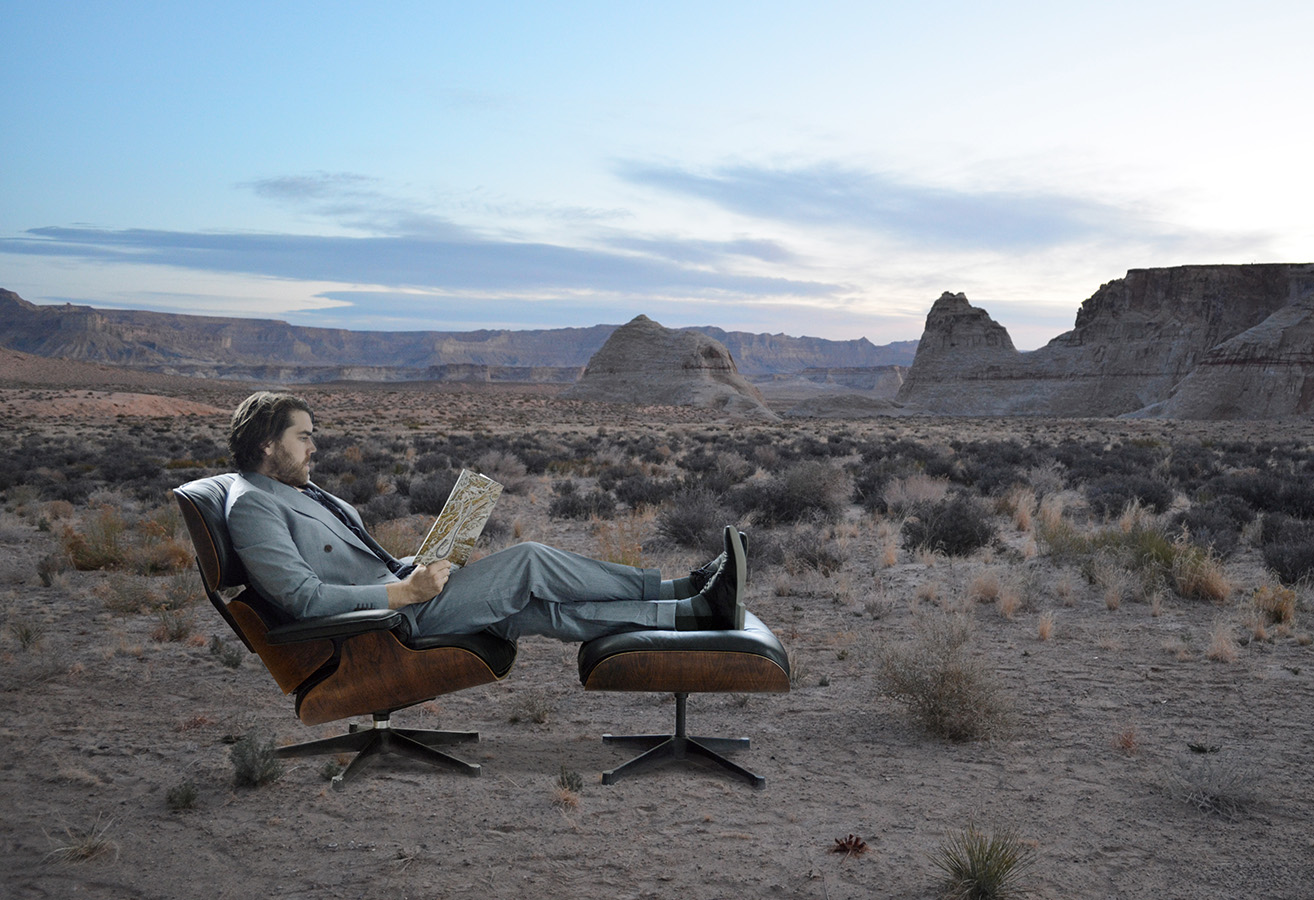
Caption:Context image showing human scale and the lounge posture the chair was designed to support.
Source: Wikimedia Commons: https://commons.wikimedia.org/wiki/File:Jens_Semjan_auf_einem_historischen_Eames_Lounge_Chair_.jpg
License: cc_by_sa
Origin:public_domain
Alt Status: actual
The cultural longevity that followed those early honors is harder to explain cleanly and easier to observe. Since the 1960s, the chair has appeared in architectural photography as shorthand for a particular kind of domestic intelligence — the room of someone who reads, thinks, and selects carefully. It shows up in film and television as ready-made character shorthand: the chair as a visual argument that its owner takes comfort seriously. Its profile is legible in silhouette alone, which is a test of icon status that very few designed objects pass. [3]
Some of this saturation has periodically diluted the chair’s distinctiveness. For a stretch, it became the default signal of the creative professional’s office — a piece of furniture used to perform taste rather than express it. But that shorthand exists precisely because the design earned it over decades of genuine use. The chair became an icon not through marketing but through continued function: it is simply, demonstrably comfortable in a way that very few modern chairs achieve across long hours and multiple body types. It accommodates reading, conversation, thinking, television, and the long slow afternoons that good furniture should never rush.
And it holds up physically in a way that flatters its owners. The modular construction — shells, cushions, base, shock mounts, all independently serviceable — means that a well-maintained Eames Lounge Chair can function for decades without meaningful degradation. [3] Both Herman Miller and Vitra offer restoration services and replacement parts for chairs of any generation. A healthy aftermarket for vintage examples exists specifically because decades-old chairs can be returned to full function with new cushions and a base cleaning — not despite the design, but because of it.
Charles Eames wanted an object worth keeping. He made something worth restoring. In furniture, that distinction matters more than almost anything else.
Meet the Designers
Charles and Ray Eames Charles Eames (1907–1978) and Ray Kaiser Eames (1912–1988) were American designers whose forty-year partnership produced some of the most enduring furniture, films, and exhibition design of the twentieth century. Working from their studio in Venice, California, they applied the same rigorous, iterative approach to every problem — from plywood experiments funded by the U.S. Navy to the landmark IBM pavilion at the 1964 World’s Fair.
Related chairs by the Eames:
- Molded Plywood Dining Chair (LCW/DCW) — the postwar experiments that made the Lounge Chair possible
- Eames Wire Chair (DKR) — the skeletal counterpart to plywood warmth
- Eames Lounge Chair variations — veneer options, base finishes, and fabric upholstery editions
References
- Wikipedia – Eames Lounge Chair
- Eames Foundation – Lounge Chair and Ottoman
- Eames.com – Lounge Chair Generation Guide
- Herman Miller / Eames Office stories (general reference)