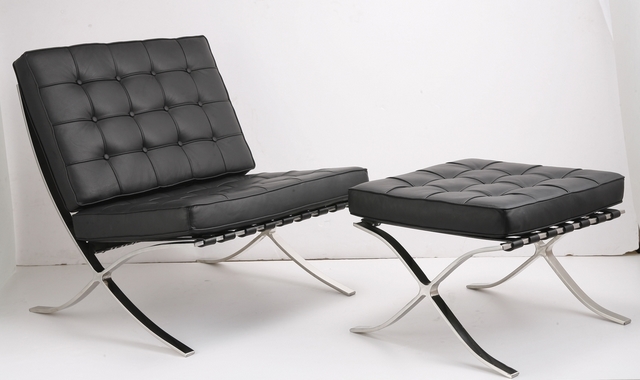
Barcelona Chair
The Barcelona Chair is a design that invites reverence. Picture the scene: the 1929 Barcelona International Exposition, a sleek German Pavilion rising in stark modernist contrast to its neoclassical surroundings. Inside, sunlight filters through vast glass panels, reflecting on polished marble and travertine. Amid this architectural symphony sits a pair of chairs, minimalist, sculptural, and yet profoundly regal. They are not just chairs; they are thrones, designed to seat Spanish royalty. One is drawn to their quiet authority and the way they seem to defy time. This is the Barcelona Chair, a masterpiece by Ludwig Mies van der Rohe and Lilly Reich, and a symbol of modernist elegance.
Meet the Designer
Ludwig Mies van der Rohe - Architect of monumental simplicity, pioneer of the International Style, and co-designer of the Barcelona Chair.Related Chairs
- Wassily Chair
- Le Corbusier LC2
- Tulip Chair (coming soon)
- Brno Chair
A Throne for Modern Royalty
The Barcelona Chair was conceived as part of the German Pavilion, which Mies van der Rohe designed for the 1929 International Exposition. The pavilion, commissioned as a showcase of German innovation and culture, was itself a manifesto of modernist ideals: open, flowing spaces, a minimal material palette, and an emphasis on precision and clarity. The chair was to be the centerpiece of this environment, designed specifically for the King and Queen of Spain to rest during their visit to the pavilion.
Mies and Reich drew inspiration from the ancient Roman sella curulis, a folding stool that symbolized authority and power. Yet, true to modernist principles, they reinterpreted this historical form in contemporary materials, chrome-plated steel and fine leather, and gave it a new, sculptural geometry. While the royal couple reportedly never sat on the chairs, their regal intent was unmistakable: to marry ceremonial grandeur with modernist restraint [1].
The Design: Simplicity Meets Elegance
At first glance, the Barcelona Chair’s design seems disarmingly simple: a sleek, X-shaped frame supporting leather cushions. But behind this apparent simplicity lies a masterclass in proportion and craftsmanship. The chair’s form is a study in balance, its arched back and angled seat create a visual and functional harmony that invites relaxation without sacrificing elegance.
Mies’ famous dictum, “less is more,” finds its fullest expression here. Every element of the chair serves both aesthetic and functional purposes. The seamless curves of the frame, for instance, eliminate unnecessary joints, while the generously tufted cushions combine visual softness with ergonomic support. This synthesis of form and function elevates the Barcelona Chair from furniture to art [2].
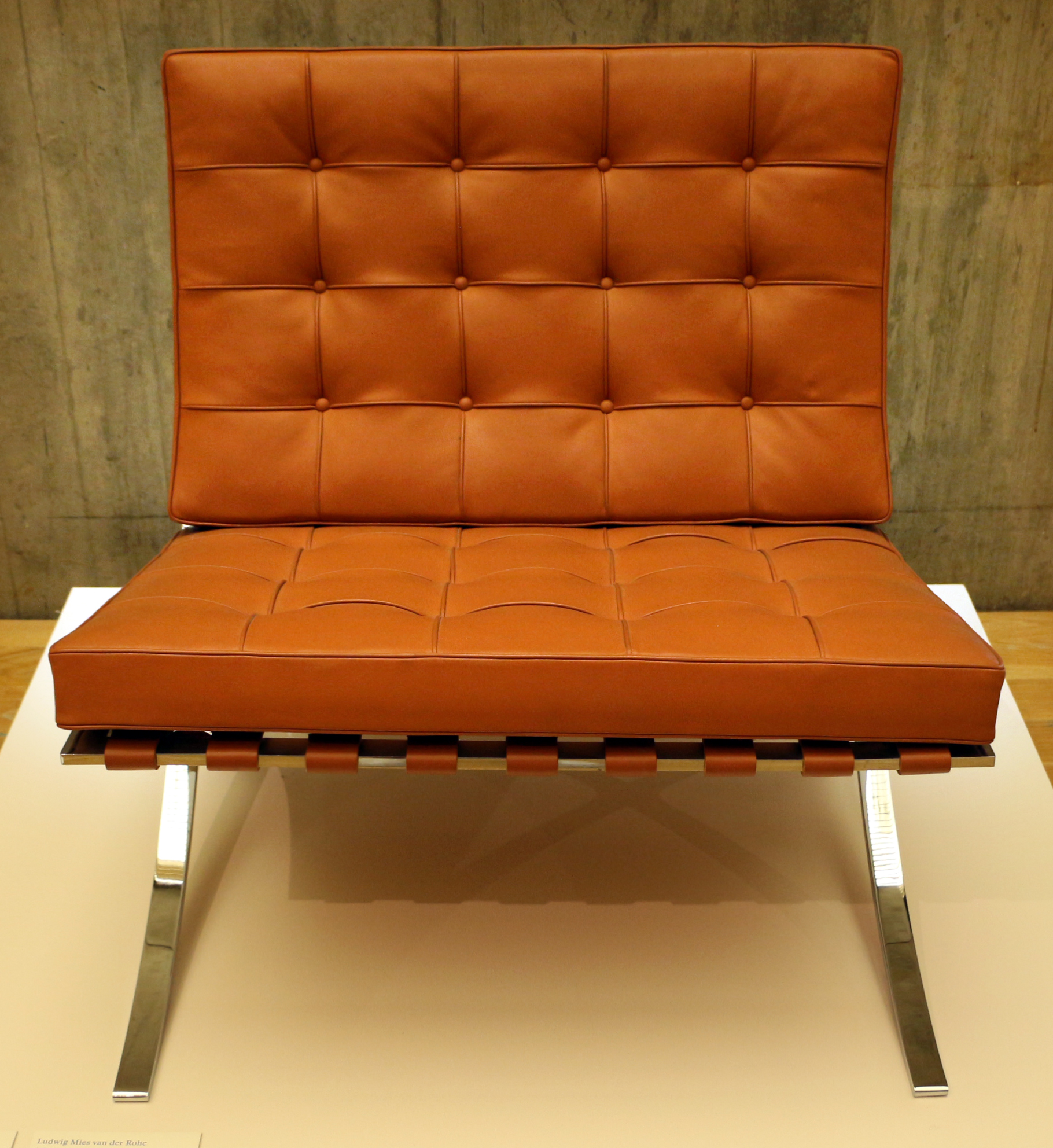
Caption:Structural view of the Barcelona Chair form and frame geometry.
Source: Wikimedia Commons: https://commons.wikimedia.org/wiki/File:Ludwig_mies_van_der_rohe,_sedia_barcelona_modello_M_R90,_1923.jpg
License: cc_by_sa
Origin:public_domain
Alt Status: actual
Crafting the Barcelona Chair: Materials and Methods
The original 1929 Barcelona Chairs were handcrafted, with frames made of chrome-plated steel and cushions upholstered in ivory-colored pigskin. At the time, the production process was labor-intensive, reflecting the chair’s status as a bespoke object rather than a mass-produced commodity. Early versions were bolted together, a necessity dictated by the manufacturing techniques of the era.
In 1950, advancements in technology allowed the frame to be reengineered as a single seamless piece of stainless steel, an innovation that enhanced both its strength and aesthetic purity. The upholstery was also updated to bovine leather, which offered greater durability and affordability. Today, each authentic Barcelona Chair produced by Knoll is handcrafted by skilled artisans, with the company maintaining the rigor of its original specifications, including the painstaking 40-hour process to upholster and assemble each chair [3][4].
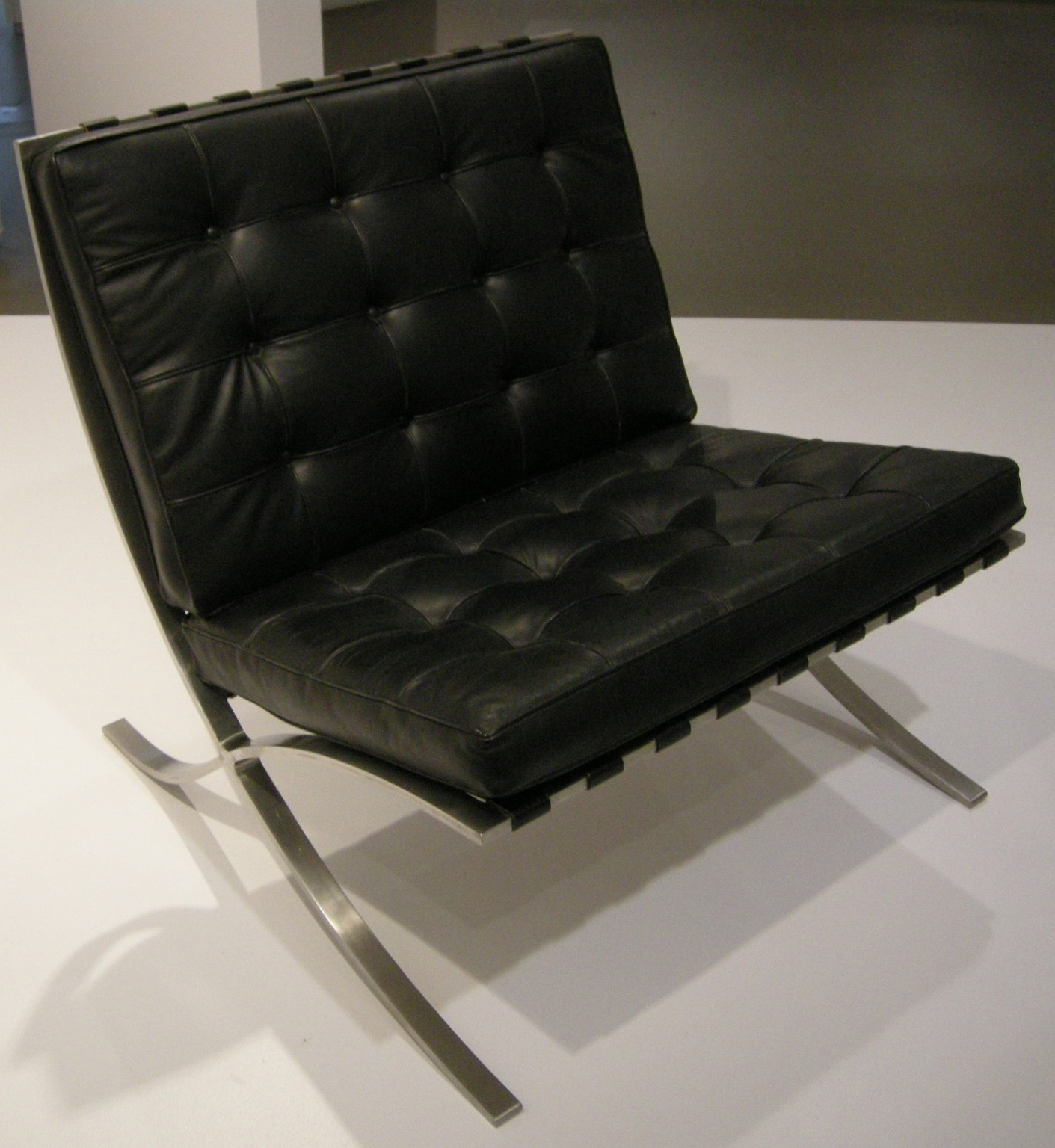
Caption:Material detail from a documented Barcelona Chair photo.
Source: Wikimedia Commons: https://commons.wikimedia.org/wiki/File:Ngv_design,_ludwig_mies_van_der_rohe_%26_co,_barcelona_chair.JPG
License: cc_by_sa
Origin:public_domain
Alt Status: actual
Mies and Reich: A Creative Partnership
While Ludwig Mies van der Rohe is often credited as the sole creator of the Barcelona Chair, the design was a collaborative effort with Lilly Reich, his longtime professional and personal partner. Reich, an accomplished designer and a key figure in the Bauhaus movement, brought her expertise in textiles and interiors to the project. Her role in the German Pavilion extended beyond the Barcelona Chair, encompassing the overall spatial and material design.
Reich’s influence is particularly evident in the chair’s upholstery, where her understanding of tactile materials helped refine the luxurious yet understated leather cushions. Though her contributions were historically overshadowed by Mies’ towering reputation, recent scholarship has brought much-deserved recognition to her role in shaping this iconic design [5].
The Legacy: From Exhibition to Icon
What began as an avant-garde showpiece has since become one of the most recognizable and celebrated pieces of modern furniture. After the exposition, the Barcelona Chair found its way into high-profile interiors, from corporate offices to luxury homes, where its clean lines and understated elegance became synonymous with sophistication.
The chair’s enduring appeal lies in its versatility. It is as at home in a minimalist loft as it is in a grand hotel lobby. Its timeless design has also made it a staple in museum collections worldwide, including the Museum of Modern Art in New York and the National Gallery of Victoria in Melbourne [6].
However, the Barcelona Chair’s status as a design icon has also made it a target for imitation. Since 1953, Knoll has held the exclusive rights to manufacture the chair, ensuring its authenticity through meticulous craftsmanship and a signature engraved on each frame. Despite this, unauthorized reproductions abound, sparking debates about intellectual property and the value of authenticity [7].
Why It Endures
The Barcelona Chair endures not merely as a piece of furniture but as a cultural artifact, a testament to the vision of Mies van der Rohe and Lilly Reich, and to the ideals of modernism itself. Its design captures a moment in history when art, architecture, and craftsmanship converged to create something timeless.
But perhaps the chair’s greatest legacy is its ability to transcend its origins. Designed for a single moment, the 1929 exposition, it has outlived its time to become a symbol of elegance and innovation, a reminder that great design is not bound by era but by its capacity to resonate across generations.
Image Review Status

Caption:Desired silhouette/context image not sourced yet. Placeholder inserted for layout review; replace with a verified source image.
Source:
License:
Origin:placeholder
Alt Status:
References
- National Gallery of Victoria. Ludwig Mies van der Rohe’s Barcelona Chair. Retrieved from ngv.vic.gov.au.
- Museum of Modern Art. Barcelona Chair Catalogue Entry. Retrieved from moma.org.
- Knoll. Design Deconstructed: Barcelona Chair. Retrieved from knoll-int.com.
- Palette & Parlor. Barcelona Chair Overview. Retrieved from paletteandparlor.com.
- Wikipedia. Barcelona Chair. Retrieved from wikipedia.org.
- Knoll. Authenticity and Craftsmanship. Retrieved from knoll-int.com.
- National Gallery of Victoria. Lilly Reich and the German Pavilion. Retrieved from ngv.vic.gov.au.